 |
| By Bob Czeschin |
Want to know one of the most remarkable things about the Iran War?
It’s how both crypto assets and stocks abandoned their respective price paths — to move virtually lockstep with oil.
As one weary Wall Street veteran put it: “We’re all oil traders now!”
There are now millions of people all over the world who pore over every tiny bit of news out of the Mideast.
They want to figure out what might come next. And get a leg up on it.
This is especially urgent now, with the ceasefire faltering and guns blazing again on both sides of the Persian Gulf.
However, there are two major misconceptions that can muddy up any clear-headed analysis of where things presently stand.
Fallacy No. 1: The White House is wrong about the blockade causing permanent damage to Iran’s oilfields.
Prior to Operation Epic Fury, Iran produced about 3.75 million barrels per day (Mbpd).
Iran consumed about 1.9 Mbpd of that production domestically.
That leaves 1.85 Mbpd that must go somewhere else.
And with exports choked off by the U.S. naval blockade, storage is basically the only alternative.
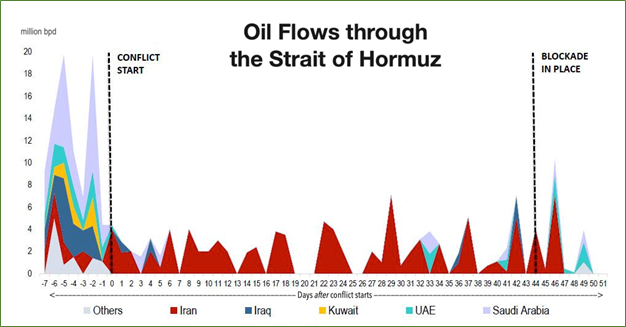
Notice how total oil flows plunged roughly 80% as Operation Epic Fury began. And, more specifically, how Iranian oil flows (in red, above) hit zero three days into the U.S. naval blockade.
They’ve remained at zero ever since.
Trouble is, Iran does not have vast amounts of petroleum storage capacity.
And when its tanks fill up, the only alternative is to shut in production.
When you do that, some conventional oilfields are prone to permanent damage.
Taking note of this, about a week ago, President Trump predicted Iran’s oil wells would “explode” in a “very powerful” destructive way in three days.
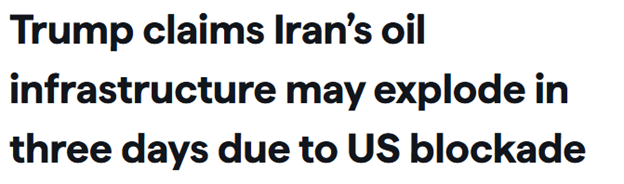
However, that deadline has since come and gone with no visible result.
What happened?
Well, shut-in production can cause irreversible damage to oilfields.
Especially in very cold climates like Siberia …
Or in regions where the crude has high wax content (like east Africa) …
And where the grade of crude produced is extra-heavy (like parts of Venezuela and Canada).
Notice, however, Iran does not appear on this list.
Iran’s petroleum heartland consists of large mature oilfields. Those draw from vast fractured limestone and dolomite formations.
The main natural oil recovery mechanism at such sites is gas-oil gravity drainage.
Natural gas is normally pumped in to speed this process.
Halting production for these oilfields means shutting off gas injections.
Even without them, however, gravity drainage still operates — albeit at far slower flow rates.
And because of this ongoing accumulation, when normal operations start again, production might actually be higher for a time than before the stoppage.
But the best evidence that export bans forcing steep production cuts are no real threat to Iran’s oilfields … is history itself.
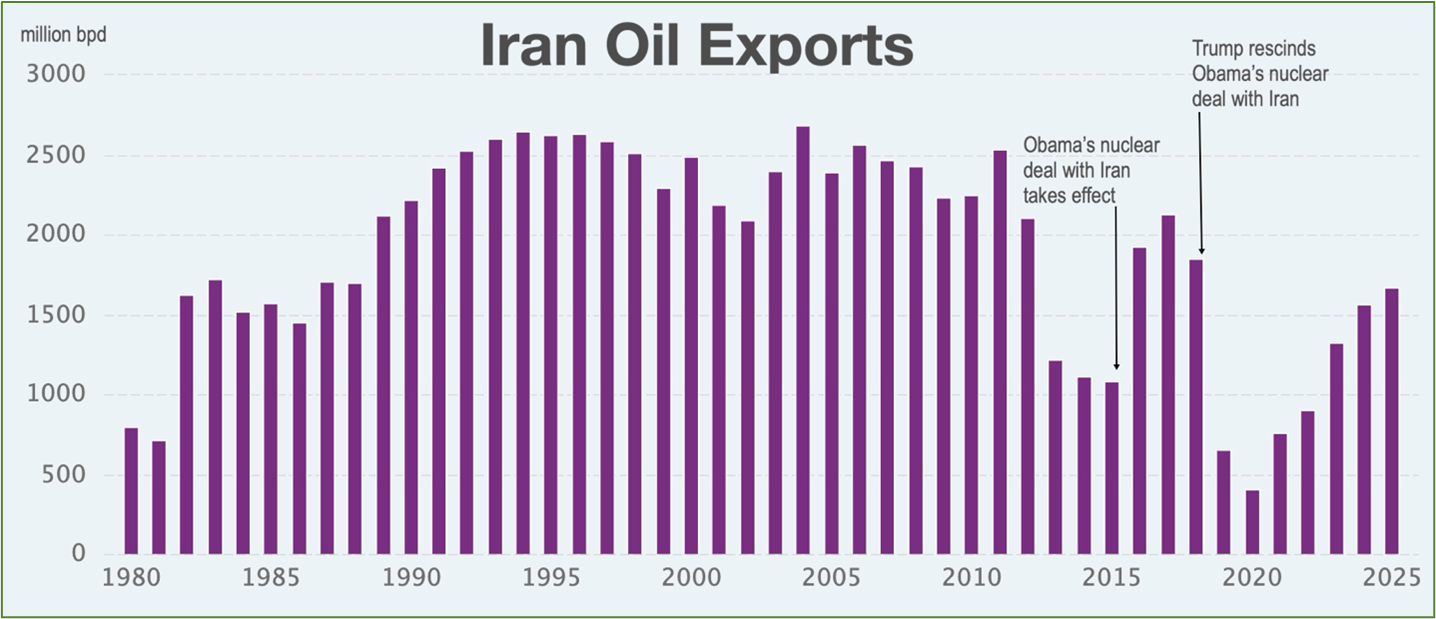
When President Obama’s nuclear deal lifted sanctions, Iran’s oil exports doubled in two years.
With no visible impairment of its ability to swiftly ramp up output following production shut-ins.
Iran was again forced to slash production sharply when Trump rescinded Obama’s nuclear deal, re-imposing sanctions.
But afterward, it was again able to restart its wells without significant problems.
And by 2025, output hit a 46-year high.
In other words, tough talk about permanent damage to Iranian oilfields is mostly wishful thinking.
Indeed, lessons learned from the post-2020 experience likely mean Tehran’s petroleum engineers are better prepared than ever to ensure Iran survives the current blockade.
Fallacy No. 2: The possible intelligence operation behind Trump’s bluster over bombing Iran power plants.
Iran’s Revolutionary Guard Corps (IRGC) is desperate to preserve and protect its stockpiles of enriched uranium.
And maximum protection implies maximum dispersal across Iran.
If this line of reasoning is correct, most of this material was probably not in the hardened mountain bunkers at Natanz and Fordow. Because everyone knew these sites were at the top of the Pentagon’s target list.
More likely, a lot of it got stashed inside urban power plants. Desalination plants. Major hospitals and mosques.
Why? Because this kind of civilian infrastructure was almost wholly untouched by 39 days of shock-and-awe aerial bombardment.
But now, these are precisely the facilities Trump’s melodramatic outburst now threatens.
Keep in mind, U.S. satellites and Israeli Defense Force (IDF) signals intelligence can see and track pretty much everything that moves inside Iran.
And you can bet your bottom dollar they’re totally zeroed in on any movement of boxes and crates out of these facilities toward undisclosed destinations.
Nuclear materials — if concealed inside these civilian sites — either stay there and get destroyed. Or they move and get identified.
Either way, Trump wins the intelligence battle before the first Tomahawk is fired.
Moreover, using loud, credible threats to create leverage is hardly new. It’s Trump’s “Art of the Deal” playbook. Which he’s used again and again.
Against North Korea. Recalcitrant NATO members. And dozens of trade partners/adversaries in the tariff wars.
High-amplitude melodrama is simply part of the process because of the uncertainty it creates in the minds of adversaries — who cannot afford to assume the threats are hollow.
Investment Implications
That Iranian oilfields are unlikely to be damaged by steep production cutbacks.
That may mean the IRGC feels less pressure to give in to U.S. and Israeli demands.
And to evade the U.S. naval blockade, they’re stepping up shipments of oil to China by rail.
A new rail corridor runs from Tehran to Chinese destinations at Yiwu and Xi’an.
Operational for about a year, it shortens transit time to 12-15 days, compared to 30-40 days by sea.
What all this points to is the IRGC being a tougher adversary than expected.
Which suggests the war will likely drag on, keeping oil prices higher for longer.
One good way to benefit from rising oil prices is with an ETF — such as the Oil & Gas Exploration & Production SPDR (XOP).
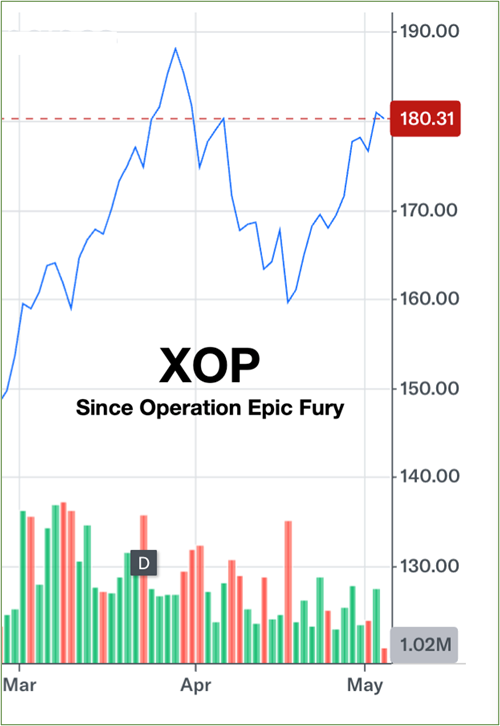
As you can see, it’s already had a decent run since the fighting began. And odds are, it’s going higher still.
Best,
Bob Czeschin
P.S. The XOP pays a 1.7% dividend, which is more than the average S&P 500 stock … but far less than anyone trying to live off their investment income needs.
Fortunately, we will be hosting a special live event on Tuesday, May 12. It will show you our “Friday Income Machine.”
If you want more income from your portfolio, you’ll want to attend.